Everything is Word of Mouth (and I’m going to prove it)

You’re standing on a busy New York street.
Cars pass. People walk by. Neon lights flicker. Nothing special.

In front of you is a small, ordinary hot dog shop. Bright lights. Plastic menus. The smell of fried onions. The kind of place you’d never remember twice.

And yet, you’re here for a reason.

Someone told you to come.

Not Yelp.
Not an ad.
A friend of yours.

You step inside. You order nothing. Instead, you walk toward the back and notice something strange: an old phone booth, squeezed awkwardly between the walls.

You step in. Close the door. Pick up the receiver and dial a number.

For a moment, nothing happens.

Then someone answers: “Do you have a reservation?”

Of course you don’t have one. Your friend didn’t tell you anything about a reservation. And, to your luck, they ignore it.

Suddenly, the wall opens.

Behind it is a completely different world: cozy dim lighting, polished wood, soft conversations, carefully made drinks. A bar that feels hidden, intentional, almost conspiratorial.

That, is the story of Please Don’t Tell (even the name is related).

You didn’t find this place.
You were invited into it.

And the most important thing isn’t what you’re drinking.

It’s what just happened to you.

Because now you have a story. A unique experience about knowing something others don’t. A story that proves you belong somewhere exclusive. You’re an insider now.

And despite the name, you think to yourself “telling it to just one person wouldn’t hurt”.

This is the power of Word of Mouth, at its finest.

Why is WOM better than any type of ad

We live in a world saturated with advertising.

We know what an ad looks like, what it sounds like, and what it wants. Not to inform, but to sell.

And because we know, we’ve adapted.

We scroll past.
We skip.
We mute.
We filter.

We modern consumers aren’t naïve. The moment we realise something tries to sell us something we become vigilant. Advertising has become a game of overcoming resistance.

Well Word of Mouth plays a different game entirely.

When a friend tells you about a restaurant, a movie, a product, or a tool, something crucial has already happened before the message even lands: they decided it was worth telling you.

That decision carries weight.

It means they thought of you.
It means they filtered information on your behalf.
It means they judged relevance, not just quality.

That’s instantly much deeper than any targeting traditional ads can achieve.

The recommendation feels:

  • more honest,

  • more targeted,

  • more personal,

  • and, paradoxically, more objective.

Not because your friend is perfectly rational—but because they don’t gain anything (obvious) by telling you. There’s no incentive structure. No campaign. No call to action. Just relevance.

It also operates below the radar.

There are metrics for ads. Impressions. Clicks. Conversions.
But there are no dashboards tracking:

  • how many times a product came up in conversation,

  • how often it was mentioned casually,

  • how many group chats it entered,

  • how many “you should check this out” moments it generated among people.

Yet, those moments quietly shape what we think, buy, and do.

Believe it or not, the things others say to us—in passing, in texts, in late-night conversations—leave traces. They build familiarity. They normalize choices. They lower uncertainty. By the time we “decide,” the decision has often been rehearsed socially.

I know. It sounds, uncomfortable, to say the least. I will make it as clear to you as possible.

How to generate buzz

– If an ad didn’t make you share it with another person, it failed its job.

This isn’t a checklist or a framework you need to follow for your next big product launch. It’s a way of thinking that has been formulated around the most studied properties that make a product or a service irresistibly shareable. 

At its core, buzz doesn’t come from people liking something.

It comes from people wanting to talk about it, and that’s significantly broader and not at all theoretical.

That urge tends to follow a few recurring patterns:

First, there’s social value.

People don’t share things just because they’re useful. They share things that make them look interesting, informed, or “in the know”. When talking about something raises a person’s social standing—even slightly—it becomes conversational fuel. This is why secrets, exclusivity, and insider knowledge spread so easily. Sharing them says something about who you are.

Second, there are triggers.

Some ideas don’t just exist on their own; they attach themselves to everyday moments. A product, phrase, or concept that’s mentally linked to something people encounter often will keep resurfacing in their minds—and therefore in their conversations. The more frequently life reminds you of something, the more likely you are to talk about it.

Third, there’s emotion.

Not all emotions are equal here. Calm satisfaction rarely spreads. High-arousal emotions—excitement, anger, awe, anxiety—do. When something makes us feel activated, we’re more likely to pass it on. Sharing becomes a way to discharge emotion socially.

Fourth, there’s visibility.

People copy what they can see. When a product or behavior is observable, it becomes easier to imitate and easier to talk about. The more public something is, the more it advertises itself—without feeling like advertising.

Fifth, there’s practical value.

People enjoy being helpful. When something saves time, money, or effort, sharing it feels generous. It turns the act of recommendation into a small social favor. This kind of sharing doesn’t feel like promotion; it feels like care.

And finally, there’s story.

Information rarely travels alone. It travels embedded in narratives. A good story carries the message along with it, without announcing that it’s doing so. The product or idea becomes part of the plot—not the headline. This is why the best “marketing” often doesn’t feel like marketing at all.

——————————————————————————————————————

When these elements come together, sharing stops being something you ask for.

It becomes something people do on their own.

Not because they were instructed to.
But because talking about it fits naturally into who they are as social creatures.

And that’s real buzz:

It isn’t engineered attention.
It’s social gravity.

Once it’s there, things move on their own.
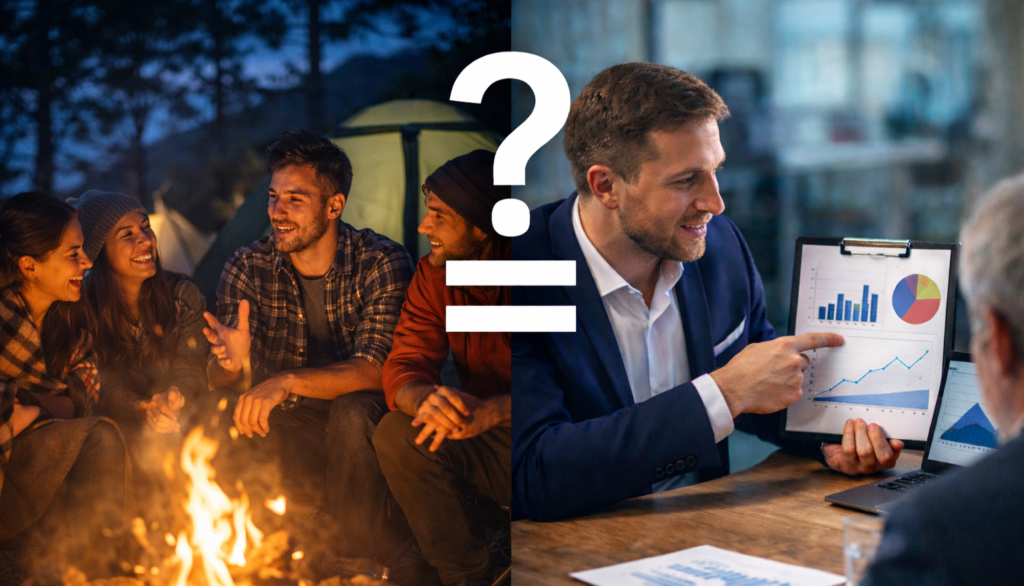
We’re all storytellers (and salespeople)

Ok, if you don’t know what I meant, I get it.

–   “How the frick do these two things have ANYTHING in common?!”

I’m certain after you read this post, the answer will fascinate you.

Before we move on, one thing you might have picked up from the picture is that there is a conversation with people in both cases. See humans are social creatures. We have evolved to hunt together, to live together. To care for one another. 

In that manner, we have developed communication mechanisms to:

1) Coordinate our actions better 

2) Provide information to another person (think of our brains as data bases transmitting to one another)

We speak this language to successfully communicate thoughts and information to people we believe should know about.

But, another important reason we communicate, is, social status.

If an important decision is to be made, people won’t follow anyone’s orders. You know that. 

But who is the question:

a) The one with the greatest arguments?

b) The most confident candidate?

c) Or the one we trust the most to know what he is doing?

The answer is NOT easy, and it will probably shock you a bit.

How we (think to) agree with people

We like to believe that agreement is the result of careful thinking.
That we listen, evaluate arguments, weigh evidence, and then—almost ceremonially—reach a conclusion.

But modern research in cognitive science and behavioral economics suggests something far less flattering.

According to theories presented in the book The Enigma of Reason, human reasoning did not evolve to help us discover truth. It evolved to help us justify our intuitions to others and to navigate social groups.

In other words, reasoning works less like a judge and more like a lawyer.

We usually decide first.
Then we reason our way backward (think about it for a second).

Studies have even shown countless of times people’s irrationality being prevalent in decision making, so, under the lens of social status, a) is out of the question.

The answer to that question is most of the time a great mixture of b) and c)

When someone speaks with confidence, our brains treat it like a signal of status and competence, especially under uncertainty. Neuroscience research on social influence shows that regions in the medial prefrontal cortex are involved in how much we “absorb” other people’s opinions, and that susceptibility to such influence is not just psychological—it has identifiable neural fingerprints. 

In another fMRI study on social hierarchy, people were more likely to conform to a superior partner in public than in private (I will not get into more detail about this, because this is a topic of its own).

Don’t get me wrong, confidence is a big part of trusting others. But trust is more universal than that. It’s about deciding whether it’s safe to coordinate with them.

And coordination is basically the hidden engine of human life.

Long before we had resumes, statistics, or “proof,” we had a simpler survival problem: Who do I move with? Who do I follow? Who do I share with? Who do I avoid? If you get that wrong, you don’t just lose an argument—you lose resources, allies, opportunities, sometimes safety.

That’s why so much of what we call “communication” is really social navigation.

Dan Ariely’s work in Predictably Irrational adds an uncomfortable twist: even when we think we’re evaluating things objectively, we’re often evaluating them relatively—through context, comparison, and feeling. So in a social environment, trust is never formed in isolation. It’s formed through tiny cues, patterns, and contrasts: consistent vs inconsistent, familiar vs unfamiliar, warm vs cold, “one of us” vs “not quite.”

This helps explain why persuasion in real life rarely looks like formal logic.

It trust-building.

It looks like tone, timing, and shared assumptions.
It looks like “I get you.”
It looks like “people like us do things like this.”
It looks like “here’s what happens next.”

And all of these comprise: a great story.

Stories do something raw data can’t: they simulate social reality. They tell you who the characters are, what they value, what they fear, what the rules are, what counts as a win, and who can be trusted. A good story doesn’t just inform. It orients.

A bit of a stop

I’m pretty sure by now you have probably raised your internal defenses (I know I did), maybe even called me mad:

At best, you’re at: “This sounds interesting, but also a bit exaggerated.”
Or worse: “This is all very deep-sounding nonsense!”

And that reaction makes sense.

Being told that arguments don’t win debates, that reasoning follows intuition, and feelings quietly steer our decisions can feel… insulting, exactly for the reasons I mentioned just now. And that is okay.

So let’s slow down for a moment.

Let’s demonstrate this concept so you get some real evidence for yourself.

A small mental experiment

You’re told one thing about a person:

  • – James has a mohawk.

That’s it. Now pause for a moment.

Don’t continue reading for a bit. Just, imagine a friend was telling you only that about a person you would meet soon after for the first time.

What occurred in your brain, just now?

Almost immediately, your mind filled in some blanks.

I didn’t tell you anything about his age, or music tastes, but most likely, you thought:

  • that he listens to punk or alternative music,

  • that he’s probably around his early to mid 30s,

  • that he dresses a certain way,

  • that he probably doesn’t work in corporate accounting.

None of this was stated. You made an educated guess.
And yet, it feels… reasonable.

This is an example discussed in another great book called Contagious, and it reveals something subtle but important: humans are extremely good at drawing rich conclusions from very little information.

Not because we’re irrational—but because we’re social.

We’ve evolved to quickly infer who someone is, what they might value, and how to interact with them. Waiting for perfect information would be inefficient. Sometimes dangerous.

So we guess (and we’re quite good at it; most of the time). And thus we can prepare tailored stories for the exact situation.

To answer question you're here for

Campers telling campfire stories aren’t just telling campfire stories. They are salespeople: they choose stories that believe fit the vibe and the people around. They choose stories that, knowing it or not, will make themselves look a bit better to others, either from their achievements they share, or the thrill and/or even practical information they provide.

A salesperson is at the same time, a great storyteller too. They don’t sell a product or a service; they sell a narrative, an emotion that they believe encapsulates what the potential client wants out of this deal.

And we people never made an important historical decision because of numbers. We were made to believe in something.

How we communicate something is many a times more important than the thing itself..